Is McDonald’s the Biggest Restaurant Chain?
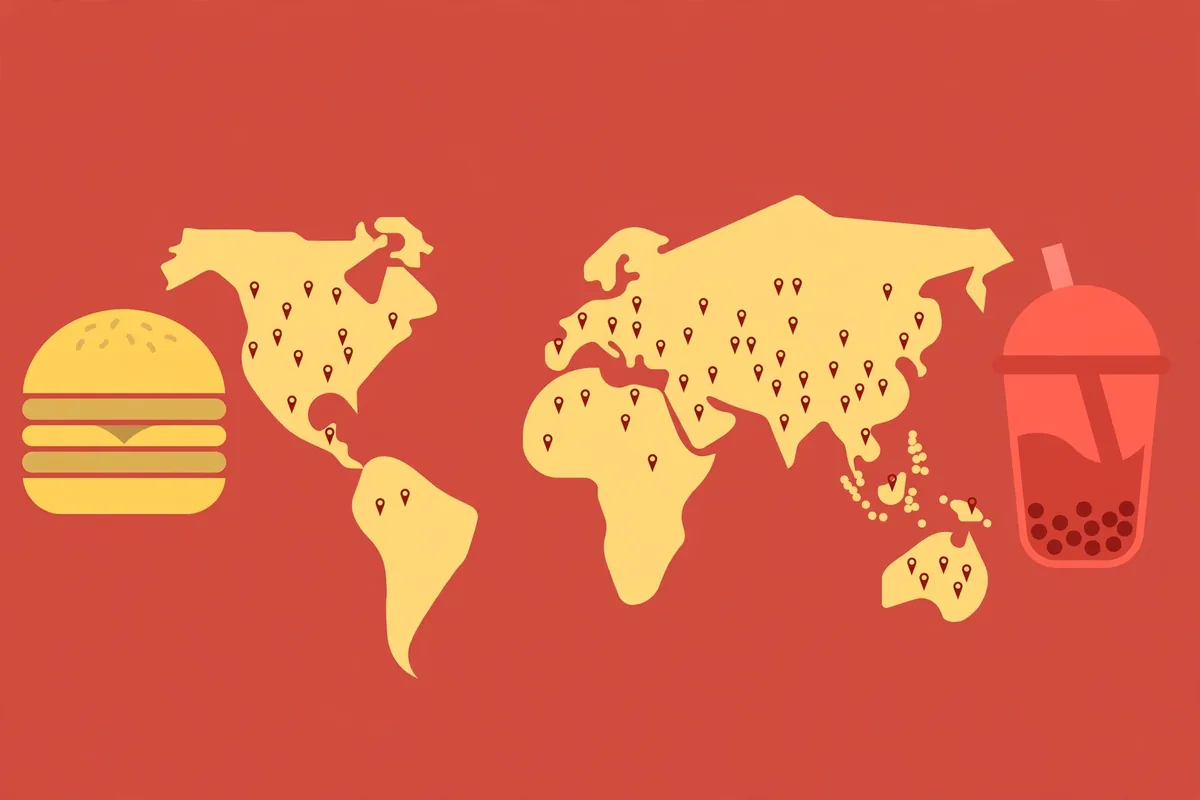
No, McDonald’s is not the biggest restaurant chain in the world by number of locations. That title now belongs to Mixue Ice Cream & Tea, a Chinese bubble tea brand with over 53,000 stores. McDonald’s sits second with about 45,000 locations, but it still leads the planet by total sales, pulling in around $139 billion a year.
Honestly, when I looked into this, I expected the answer to be simple. McDonald’s, right? Golden arches everywhere, on every corner of the planet. I mean, hasn’t that just always been true?
Turns out, not anymore. At least not the way most people mean “biggest.” The answer depends entirely on how you count, and the chain sitting on top by store count is one you’ve probably never even heard of. Here’s the full story.
So Who Is the Biggest Restaurant Chain in the World Right Now?
By store count, the biggest restaurant chain in the world is Mixue Ice Cream & Tea, a Chinese bubble tea and soft-serve chain with roughly 53,000 locations. McDonald’s, with about 45,000, comes in second, followed by Starbucks at around 41,000.
Pronounced “ME-schway,” Mixue started way back in 1997 when a student named Zhang Hongchao opened a little shaved-ice stall in Henan, a province in central China, just to help his family make ends meet. Almost three decades later, his $1 bubble tea empire has more stores than McDonald’s and Starbucks. Wrap your head around that.
How did it grow that fast? The recipe is almost boring in its simplicity. Everything on the menu costs around 6 yuan, less than a dollar. The stores are tiny, often just bright red stalls wedged next to phone-repair kiosks. Nearly every location is franchised, and Mixue makes most of its money not from selling drinks to you, but from selling supplies to its franchisees. More than doubled its store count in just three years. And here’s the kicker: in March 2025, Mixue raised about $444 million in a blockbuster Hong Kong IPO, one of the biggest of the year.
Most of its stores are in smaller Chinese cities, places where a 6-yuan cone hits exactly right in a rough economy. But it keeps spreading, already operating in a dozen countries across Asia and Australia.
Then What Happened to McDonald’s?
Nothing. It’s doing just fine. McDonald’s is still the biggest restaurant chain in the world by sales, and it’s not even close. In the latest Franchise Times Top 400 ranking, McDonald’s held the number one spot with $139.4 billion in global revenue, up nearly 7 percent. In the US alone, its restaurants pulled in about $55 billion in 2025 across roughly 13,700 locations, making it the top American fast food chain by a mile.
That’s the part people forget. A Mixue store sells dollar lemonades out of a kiosk. A McDonald’s sells Big Macs, fries, and breakfast to a whole neighborhood. So while Mixue wins on store count, McDonald’s earns more than most chains combined.
Chick-fil-A actually proves this point even better. It has barely 3,300 US restaurants, a fraction of McDonald’s footprint, yet it ranks among the top US chains in sales because each store rings up an enormous amount. Store count and sales tell two very different stories.
This Crown Has Changed Hands Before
If you’ve been paying attention for a while, you might remember that McDonald’s lost this title once already. Subway, yes, Subway, the sandwich chain, once had more restaurants worldwide than McDonald’s, crossing the line with tens of thousands of stores in the early 2010s. For years it was the answer to the “biggest” question.
Then the closings started. Thousands of them. Subway shrank to around 35,000 locations as franchisees struggled, and McDonald’s took the crown back. Now Mixue has grabbed it again, and its formula is suspiciously similar to Subway’s old playbook: cheap, simple, franchised to the max, and absolutely everywhere.
The pattern is pretty funny when you think about it. The “biggest” title keeps going to whichever chain figures out how to open the most tiny, cheap, franchise-friendly stores. McDonald’s hasn’t changed. The yardstick did.
What Does “Biggest” Actually Mean, Anyway?
It depends on the scoreboard you’re looking at. By locations, it’s Mixue (53,000), then McDonald’s (about 45,000), then Starbucks (about 41,000). By sales and revenue, McDonald’s is untouchable at $139 billion a year. By brand value and cultural footprint, most people would still say the golden arches win walking away.
So the next time someone asks, “Is McDonald’s the biggest restaurant chain?” the honest answer is: by stores, no, not anymore, but by money and fame, still the king. Most rankings that crown a winner on location count will name Mixue. Most rankings that crown on dollars will name McDonald’s. Both are right. You just have to say which game you’re watching.
❓ Frequently Asked Questions
What is the biggest restaurant chain in the world?
By number of locations, it’s Mixue Ice Cream & Tea, a Chinese bubble tea chain with over 53,000 stores. McDonald’s is second with about 45,000 locations.
Is McDonald’s bigger than Starbucks?
Yes, McDonald’s has more locations (about 45,000 vs 41,000) and far higher global sales. Starbucks is the third-largest chain by store count worldwide.
Which restaurant chain has the most locations?
Mixue Ice Cream & Tea, with roughly 53,000 locations across China and a dozen other countries. It’s nearly all franchised and sells drinks and ice cream for under $1.
Does McDonald’s make more money than any other restaurant chain?
Yes. McDonald’s leads all restaurant chains in global revenue at about $139 billion a year, comfortably ahead of every competitor by sales.