Why Is Chick-fil-A’s Drive-Thru So Fast?
Honestly? By the stopwatch, it’s not. Chick-fil-A’s drive-thru actually runs slower than Taco Bell’s or Wendy’s — the 2026 QSR Drive-Thru Report clocked it at 7 minutes and 5 seconds, nearly three minutes behind the fastest chain. But per car, Chick-fil-A moves customers through faster than any other major chain, and their face-to-face ordering system makes the line feel like it’s flying.
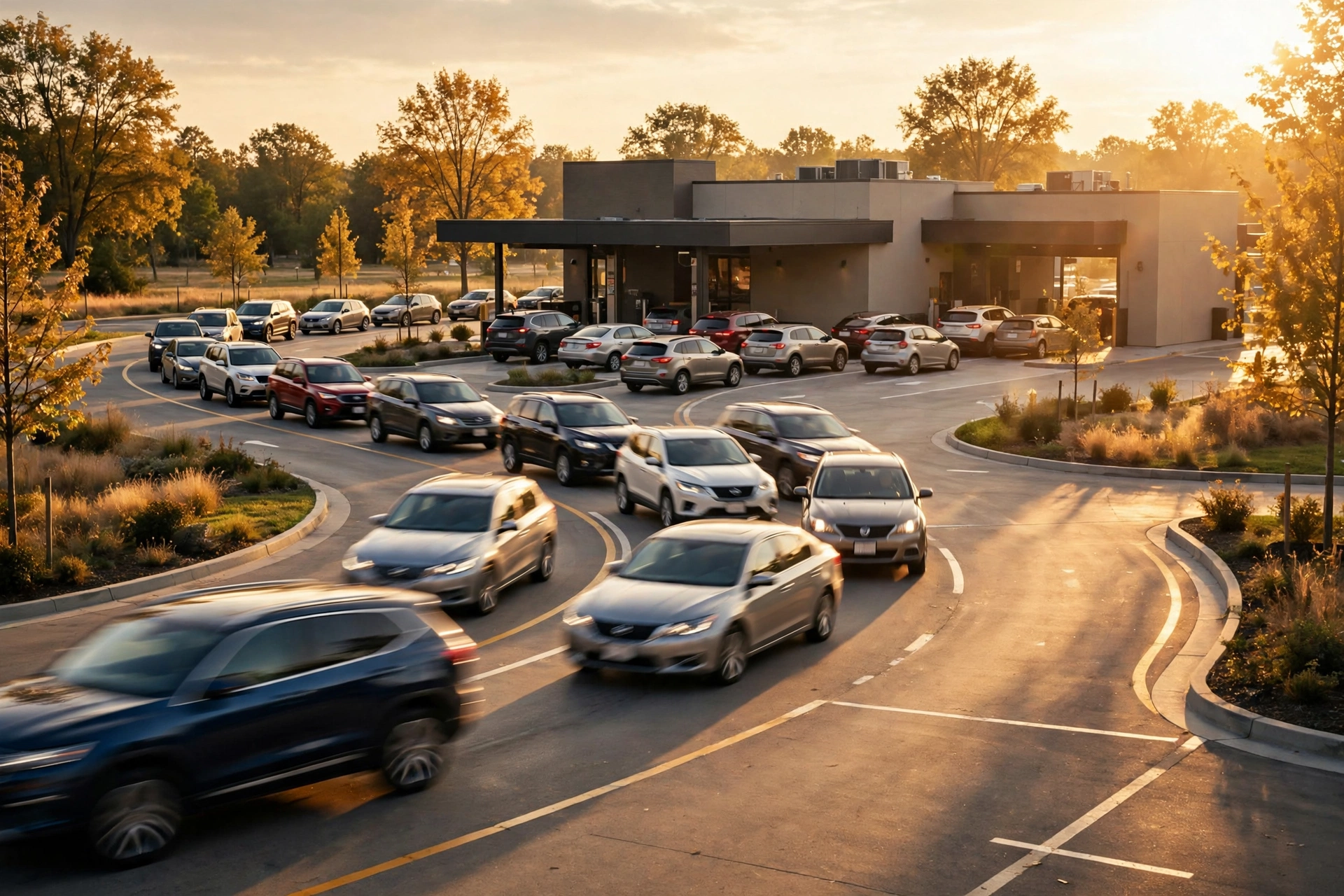
Here’s the thing — drive-thru “speed” is one of the most misunderstood stats in fast food. People pull into a Chick-fil-A line, see fifteen cars snaking around the building, and brace themselves. Then they’re through in minutes, food hot, order right, someone smiling at every window. So how does the chain with the slowest measured drive-thru have the happiest drive-thru customers in America? I looked into this, and the answer is pretty fascinating.
The Stopwatch Says One Thing…
Every year, QSR Magazine and Intouch Insights send mystery shoppers through America’s drive-thrus with a standardized order, and every year Chick-fil-A lands near the bottom for total time. In the 2025 report, it clocked 7 minutes and 6 seconds — the slowest of the chicken chains. In 2026, it posted 7:05. Meanwhile Taco Bell keeps winning the classic category, recently hitting 4 minutes and 16 seconds.
Does that mean Chick-fil-A is bad at drive-thrus? Not even close. Here’s the catch the headline numbers miss: Chick-fil-A serves way, way more cars. Their freestanding drive-thru restaurants pulled median annual sales of $9.088 million in 2025, with one location earning over $20 million. Of course the line looks long. There are simply more people in it.
And when researchers divided total time by the number of cars in line, Chick-fil-A was suddenly the fastest chain in America at 156.97 seconds per car — beating Dutch Bros at 167.55 and Raising Cane’s at 179.97. The line moves fast. There are just a lot of people in it.
Why the Chick-fil-A Drive-Thru Fast-Lane Feeling Works
This is where the real magic happens. Chick-fil-A doesn’t rely on the speakerbox like most chains do. Instead, team members walk the line with tablets, taking orders from cars before they ever reach the menu board. This is called face-to-face ordering, and it’s the single biggest reason the Chick-fil-A drive-thru feels fast.
Think about a normal drive-thru. You wait behind three cars, each one slowly ordering at the speaker. At Chick-fil-A, an employee with a tablet has already taken your order by the time you’re halfway to the window. The kitchen starts making your food before you finish talking. By the time you pull up to pay, your chicken sandwich might already be bagged.
Then there’s the staffing. Chick-fil-A famously sends team members outside to run payment down the line, so the car at the window isn’t fumbling with cards and change. Nobody’s sitting idle. The whole operation is a moving conveyor of human beings, and it never stands still.
Dual Lanes and the Kitchen of the Future
Most Chick-fil-A locations run multiple drive-thru lanes, but the company went even further in August 2024. They opened their first “elevated” drive-thru at Jodeco Road in Stockbridge, Georgia — a two-story, drive-thru-only restaurant with four lanes and a kitchen on the second floor.
How does the food get down? A sophisticated conveyor belt carries each meal from the elevated kitchen to a team member on the ground below. The kitchen is twice the size of a typical Chick-fil-A kitchen, and the conveyor system can deliver a meal to a team member every six seconds. The four-lane setup holds two to three times more cars than a standard drive-thru. Guests either order ahead in the app and use dedicated mobile thru-lanes, or order from a real person in the traditional lanes.
It’s basically a drive-thru factory — and it exists because Chick-fil-A knows its biggest problem isn’t speed. It’s volume.
Service Over Speed: The “My Pleasure” Effect
Here’s the wild part. In the 2026 Drive-Thru Report, Chick-fil-A scored 98.2 percent overall satisfaction — the highest of any chain. Just 12.1 percent of visitors said the speed felt “slower than expected,” which was lower than chains that were literally faster. And only 0.6 percent rated the flow as “frustrating and inefficient” — the lowest in the entire report.
Why? Because people are constantly moving and constantly being talked to. You get a friendly greeting from a team member with a tablet. Someone runs your payment up to your window. You get eye contact, a smile, and — yes — “my pleasure” at the handoff. The friendliness score was 93 percent, also the best in the business.
Time flies when you’re not bored. That’s not a slogan — it’s the actual psychology of waiting. A moving, engaging wait feels short. A static, ignored wait feels endless. Chick-fil-A figured this out, and they’ve basically weaponized hospitality.
How Long Is the Chick-fil-A Drive-Thru Wait, Really?
If you’re asking how fast the Chick-fil-A drive-thru is on a normal Tuesday lunch rush, expect around six to eight minutes from the moment you join the line to the moment you drive away with your food. At peak dinner hours, it can push past ten. But here’s the thing — that time includes a line that would take fifteen minutes at a slower operation.
Compare it to the “fast” chains: Taco Bell moves through in just over four minutes, but their lines are usually shorter and less busy. Chick-fil-A’s lines are long because everybody’s in them. It’s a victim of its own success, and the chain keeps redesigning its restaurants just to keep up.
What Other Chains Could Steal From Chick-fil-A
A lot of chains have tried to copy the playbook. Taco Bell rolled out AI voice ordering at hundreds of drive-thrus. Others are testing multiple lanes and mobile-order pickup windows. But the tablet-in-the-line system? That’s hard to copy because it requires one thing most chains won’t pay for: enough employees.
Chick-fil-A’s drive-thru works because the chain staffs it like a restaurant, not like a kiosk. Real people, outside, in the weather, talking to every single car. That’s expensive. But when your average drive-thru location does nine million dollars a year in sales, you can afford a few extra team members.
So is the Chick-fil-A drive-thru fast? Depends on what you’re measuring. The stopwatch says no. The per-car math says yes. And the millions of people who keep pulling into those long lines? They’ve already made up their minds.