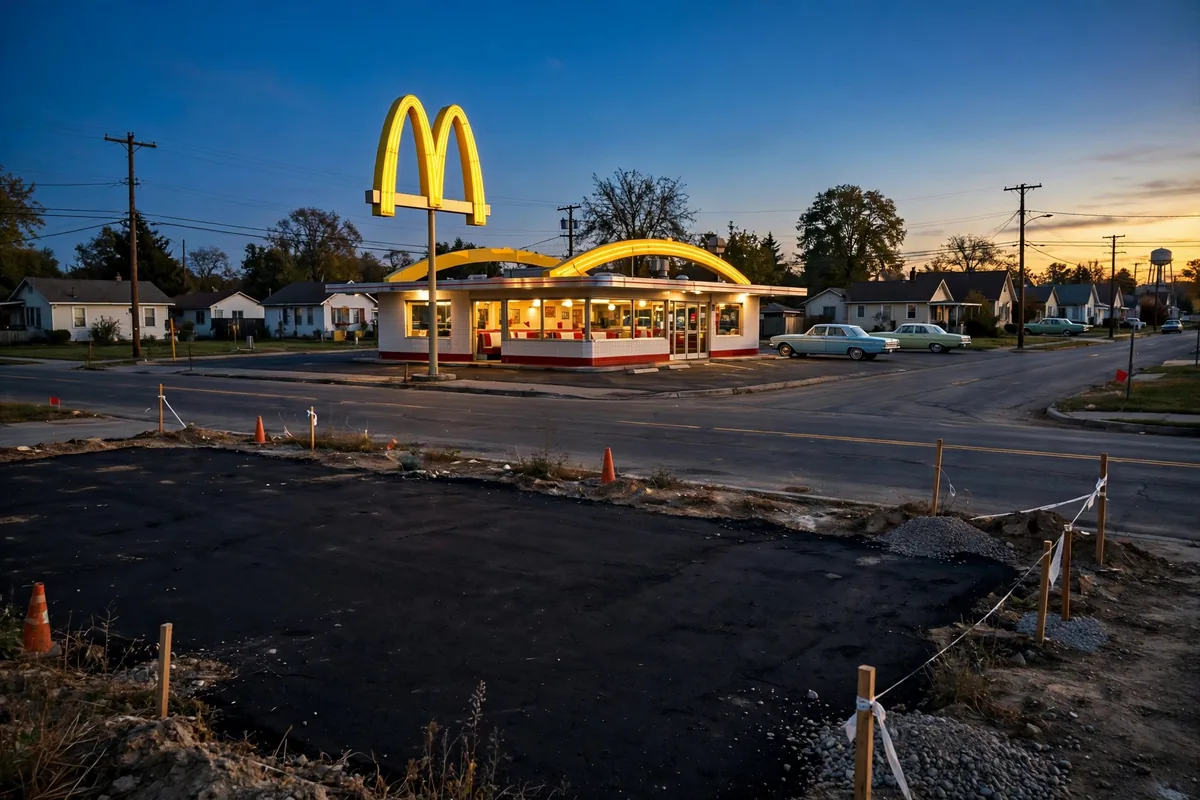
Is McDonald’s a Real Estate Company?
Is McDonald’s a real estate company? Not on paper, but the label fits better than you’d think. McDonald’s owns roughly 56% of the land and 80% of the buildings under its restaurants, and it collects billions of dollars in rent from franchisees every year. The burgers are the draw, but the ground underneath is the business.
Honestly, this is one of my favorite business stories. You drive past a McDonald’s and think “burgers,” but the company’s own reports show it’s one of the largest commercial real estate holders on the planet. It started in the 1950s, when Ray Kroc couldn’t make money even as new restaurants kept opening, until finance guy Harry Sonneborn walked in with an idea that quietly turned the whole company into a money machine.
How Did McDonald’s Become a Real Estate Empire?
It became one because its first CFO, Harry Sonneborn, realized in 1956 that the real money wasn’t in burgers, it was in the dirt the burgers were sold on. He set up the Franchise Realty Corporation to buy land along well-traveled roads, then lease it back to franchisees at a markup.
Here’s the thing. Early McDonald’s franchisees were ordinary folks who couldn’t afford to buy land and build a restaurant on it. So Sonneborn flipped the problem into a model: the company would buy or lease the land and building, then sublease it to the franchisee at a markup, originally up to 40% of the root lease or 5% of sales, whichever was greater.
That deal did three brilliant things at once: instant cash flow to fund more expansion, franchisees who could open with almost no real estate money of their own, and, the masterstroke, total control of the location itself. A franchisee who falls out of line can be replaced. The corner lot stays with the company.
Sonneborn said it best: “We are not basically in the food business. We are in the real estate business. The only reason we sell fifteen-cent hamburgers is because they are the greatest producer of revenue, from which our tenants can pay us our rent.”
How Much Land Does McDonald’s Actually Own?
A lot. As of its 2025 annual report, McDonald’s owned about 56% of the land and 80% of the buildings under its restaurants in consolidated markets. With 45,000+ locations across 100+ countries, that’s tens of billions in property.
McDonald’s Real Estate in Numbers
| Figure | Value | Details |
|---|---|---|
| Global restaurants | 45,356 | Total locations at year-end 2025 |
| Franchised restaurants | ~95% | Only about 5% are company-operated |
| Land owned | ~56% | In consolidated markets, per the 2025 annual report |
| Buildings owned | ~80% | In consolidated markets, per the 2025 annual report |
| Net property & equipment under franchise | $22.8B | Including $7.1B of land, per the 2025 annual report |
Those are book values, what the properties are carried at after depreciation. The actual market value of land, much of it prime corner lots bought decades ago, is estimated far higher, with analysts routinely floating figures around $100 billion or more.
Control runs even deeper than ownership. Where McDonald’s doesn’t own the land, it usually holds the long-term lease and subleases to the franchisee. Agreements run 20 years, and when one ends, McDonald’s decides: renew, replace the operator, or close. A franchisee can leave the system. They can’t take the location with them.
Where Does McDonald’s Really Make Its Money: Burgers or Rent?
Rent, and it’s not close. Franchisees pay a 4% royalty on sales plus rent on the property, and rental income is the bigger stream: billions of dollars every year. That alone makes McDonald’s one of the largest landlords on earth.
Think of each restaurant as a little building with one tenant. The tenant sells burgers, pays rent plus royalties, and handles the daily grind. McDonald’s corporate doesn’t flip patties at 95% of its restaurants. It cashes checks.
The leases are typically triple-net, which is landlord heaven: the franchisee pays property taxes, insurance and maintenance on top of the rent. Rent is usually a percentage of gross sales, commonly 8% to 15%, on top of the 4% royalty. So for every dollar a busy restaurant brings in, a double-digit slice flows to McDonald’s before the franchisee sees a dime.
So Is McDonald’s Technically a Real Estate Company or a Restaurant Company?
Technically it’s a restaurant franchisor, and Wall Street values it as one. But the most honest description: a franchisor whose economic engine is built on controlling the real estate beneath nearly all its restaurants.
Here’s why the distinction matters. Controlling the land gives McDonald’s power no ordinary franchisor has: the power to enforce standards. Remodel. Upgrade your tech. Follow the playbook. Disagree? You can’t take the corner with you. That’s how 45,000+ restaurants in 100+ countries stay one brand.
Next time you pull into a McDonald’s parking lot, remember: you’re not just buying a Big Mac. You’re standing on one of the biggest private real estate portfolios in the world. The fries paid for the dirt, and the dirt pays for everything. For a different flavor of the same game, see how much it costs to open a Chick-fil-A franchise, where you pay $10,000 and never own a thing.
❓ Frequently Asked Questions
Is McDonald’s a real estate company?
Not officially, it’s a restaurant franchisor. But McDonald’s owns roughly 56% of the land and 80% of the buildings under its restaurants, and collects billions in rent from franchisees every year.
How much real estate does McDonald’s own?
Per its 2025 annual report: about 56% of the land and 80% of the buildings in consolidated markets, with $22.8 billion in property and equipment under franchise arrangements. The open-market value is estimated much higher.
Does McDonald’s own the land under its restaurants?
Mostly, yes. Where it doesn’t own the land outright, McDonald’s usually holds the long-term lease and subleases it to the franchisee. Agreements run 20 years, and McDonald’s keeps control of the underlying real estate.
How does McDonald’s make money from franchisees?
Three ways: an initial franchise fee, a 4% royalty on sales, and rent on the restaurant property, usually a percentage of gross sales. Rent is the largest of the three.
Figures last verified: October 10, 2026, from McDonald’s public annual reports. For the official source of truth on the company’s business model and franchise program, visit the official McDonald’s website.